

Researchers Release POSEIDON, the Largest Physics‑Informed Earthquake Prediction System and Open Global Seismic Dataset
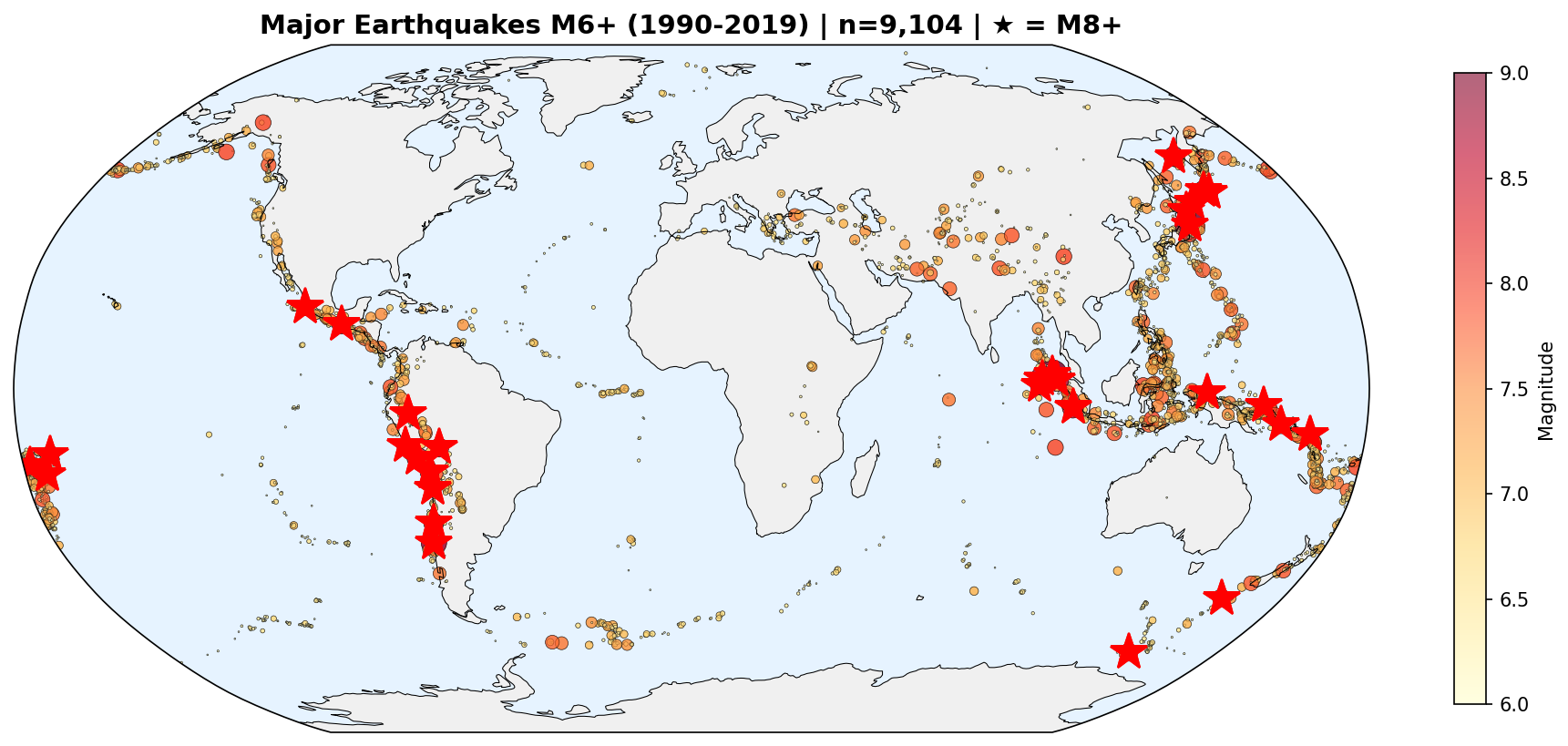
POSEIDON Earthquake Map
New AI framework integrates established seismological laws with deep learning, achieving state‑of‑the‑art performance yet maintaining physical interpretability
HONG KONG, January 12, 2026 /EINPresswire.com/ -- A research team from The Hong Kong University of Science and Technology and the University of Technology Sydney has released POSEIDON (Physics‑Optimized Seismic Energy Inference and Detection Operating Network), a large‑scale, physics‑informed artificial intelligence system designed to improve earthquake prediction and hazard assessment.Alongside the model, the researchers have published the Poseidon Dataset, the largest open‑source global earthquake catalog assembled to date, comprising 2.8 million seismic events spanning more than 30 years of worldwide observations. The dataset is publicly available to the research community.
POSEIDON represents a departure from conventional “black‑box” machine‑learning approaches in seismology. Rather than treating physical laws as external validation tools, the system embeds core seismological principles directly into its neural network architecture as learnable constraints. These include the Gutenberg–Richter magnitude–frequency relationship and the Omori–Utsu aftershock decay law, ensuring that model predictions remain consistent with established physical theory.
“Earthquake science already has well‑validated physical laws describing how seismic events behave,” said Boris Kriuk, researcher at The Hong Kong University of Science and Technology. “POSEIDON demonstrates that incorporating those laws directly into AI systems does not reduce predictive power—it improves it while preserving scientific interpretability.”
Unified Modeling of Seismic Phenomena
The system addresses three interrelated seismic challenges within a single multi‑task framework:
1. Aftershock sequence identification
2. Tsunami generation potential assessment
3. Foreshock detection preceding major earthquakes
By modeling these phenomena jointly, POSEIDON captures their shared physical structure, improving overall predictive performance compared with models that treat each task independently.
In extensive evaluations, POSEIDON outperformed gradient boosting, random forest, and conventional neural network baselines across all tasks. Notably, the system achieved an AUC score of 0.971 for tsunami detection, despite tsunami‑generating earthquakes representing only 1.14% of the dataset.
Physically Meaningful Results
Beyond accuracy, the model’s learned parameters converged naturally to values consistent with established seismological literature. The inferred Gutenberg–Richter b‑value converged to 0.752, while Omori–Utsu parameters reached p = 0.835 and c = 0.1948 days, reinforcing confidence in the model’s physical validity.
According to Fedor Kriuk of the University of Technology Sydney, “Achieving both operational‑level accuracy and scientific transparency is essential for high‑stakes applications like earthquake and tsunami warning systems. POSEIDON shows that physics‑informed AI can meet both requirements simultaneously.”
The Poseidon Dataset
The newly released dataset includes:
i. Global seismic events ranging from magnitude 0.0 to 9.1
ii. Pre‑computed energy‑based features
iii. Spatial grid indices for geospatial analysis
iv. Standardized quality metrics
v. Multi‑scale temporal context windows (7, 30, and 90 days)
The dataset is intended to support future research in earthquake forecasting, hazard modeling, and physics‑informed machine learning.
Future Directions
The research team plans to extend the system to incorporate real‑time seismic waveform data, continuous probabilistic hazard forecasting, and crustal stress‑transfer physics, with the goal of improving early‑warning capabilities and risk assessment frameworks. The full technical details are available via a publicly accessible research preprint.
About the Research Team
The project is a collaboration between researchers at The Hong Kong University of Science and Technology and the University of Technology Sydney, focusing on physics‑informed artificial intelligence for high‑risk scientific and engineering applications.
Boris Kriuk
Hong Kong University of Science and Technology
+852 9162 6635
email us here
Legal Disclaimer:
EIN Presswire provides this news content "as is" without warranty of any kind. We do not accept any responsibility or liability for the accuracy, content, images, videos, licenses, completeness, legality, or reliability of the information contained in this article. If you have any complaints or copyright issues related to this article, kindly contact the author above.
